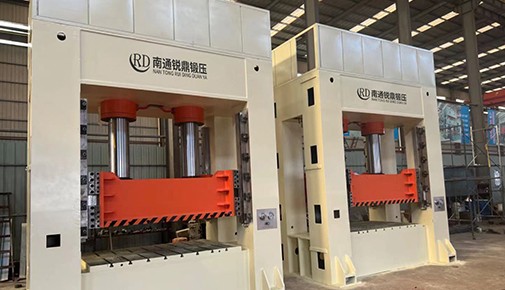
In the process of manufacturing workpieces, hydraulic presses have deformation resistance for each workpiece
 Release time:2026.01.16
There is a movable beam in the hydraulic press. I believe many people know that its operating speed depends on the amount of liquid supplied by the pump, and is not related to the resistance caused by the deformation of forged parts during the manufacturing process of the workpiece.
If the hydraulic supply of the hydraulic press is determined, the operating speed of the hydraulic press is also determined and is not affected by other factors.
In the process of manufacturing workpieces, each workpiece has deformation resistance, but the supply pressure of the pressure pump and the power consumed by the hydraulic press are proportional to the deformation resistance. The greater the degree of deformation, the greater the power consumption and the greater the degree of deformation. The smaller the power consumption, the lower the power consumption. Direct conveying hydraulic press has many advantages. For example, his basic investment required is very small, and he has a small size and footprint, making maintenance and cleaning in daily life very simple. However, when the operating power is very low, the effectiveness of the hydraulic pump may not be good. Therefore, it is recommended to set up a hydraulic press to operate the machine, which not only facilitates production but also protects the hydraulic press and improves its service life.
A hydraulic press is a machine that uses liquid as the working medium and is based on Pascal's principle to transfer energy to achieve various processes. A four column hydraulic press generally consists of three parts: the machine (main engine), the power system, and the hydraulic control system. Four column hydraulic presses are divided into valve hydraulic presses, hydraulic presses, and engineering hydraulic presses.
(1) The impact during reversing and shifting.
(2) Serious leakage. Most people believe that it is not related to temperature rise. Everyone knows that leaks can cause energy loss. Then, what is converted into energy loss is actually all converted into heat energy, causing the oil temperature to rise.
(3) Air or moisture in oil. When the hydraulic pump of the hydraulic press converts oil into pressure oil, if there is air and water, the heat will increase and cause overheating.
(4) Poor heat dissipation. When choosing a design, if the fuel tank is too small, the oil circulation is too fast, or a cooler is used due to high ambient temperatures, but the cooling effect is poor, resulting in poor heat dissipation.
(5) The system uninstallation circuit has malfunctioned. Unloading valves are usually provided at the pump outlet of the system. When the system is not loaded with pressure oil, it will unload to reduce energy loss. If the unloading valve malfunctions, when no pressure oil is needed, the oil will still overflow from the relief valve to the oil tank, which will increase the oil temperature.
 Chinese

 Release time:2026.01.16